
The First Decision Isn’t the Building. It’s the Team.
Renovate or build new? The best answer starts with a clear business need and the right people asking the right questions.
A West Michigan manufacturer wanted to add roughly 10,000 square feet to a facility it had occupied for 30 years. At first, an addition seemed like the obvious way to gain space without moving.
Then the team reviewed the existing building. The facility relied on a well and had no fire-suppression system. For that project, the proposed addition triggered requirements to upgrade fire protection throughout the facility, including water storage, pumps, and other infrastructure that hadn’t been in the initial budget.
The addition hadn’t changed. The economics had.
That’s why the renovate-versus-build-new decision shouldn’t begin with a price comparison. It should begin with a better question: Do we have the right people in the room to evaluate our options?
Start with the business problem
Most owners are trying to solve something bigger than a space shortage. It might be a bottleneck on the production floor, aging infrastructure, plans for growth, or a need to expand without interrupting operations.
A renovation may protect the workforce and extend the life of an existing asset. A new facility may allow a better layout and more room for future growth. Sometimes reconfiguring the current operation can reduce the need for construction altogether.
The question isn’t simply what costs less to build. It’s what will serve the business best over the next five, ten, and twenty years.
Bring the right expertise together early
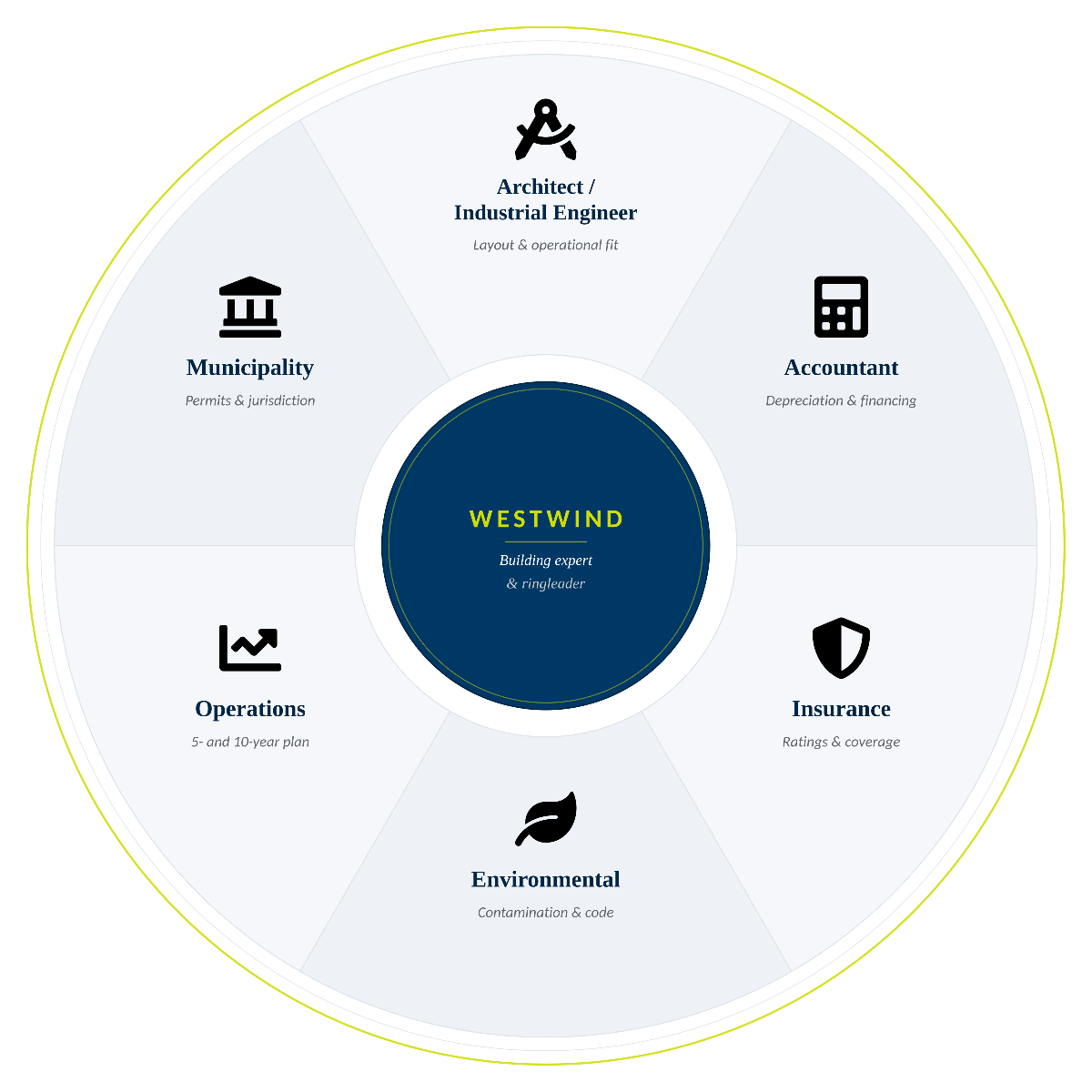
No single expert sees the whole picture. A sound decision draws on people who can answer different questions:
- Architect or industrial engineer. Can the space support today’s operations and future needs?
- Operations leadership. How will production, staffing, and growth change over time?
- Accountant or financial advisor. How do financing, taxes, depreciation, and ownership costs affect the choice?
- Insurance advisor. What do building age, systems, and coverage mean for ongoing costs?
- Environmental specialist. Could conditions or prior uses create remediation work?
- Municipality and permitting officials. What do zoning, setbacks, codes, and approvals allow?
- Construction partner. What are the likely scope, schedule, phasing, and construction risks?
This is where Westwind adds value. We help bring the right people and questions together, identify issues owners may not know to look for, and keep the decision connected to the business goal. We don’t have to be the expert in every discipline to know when that expertise belongs at the table.
Four factors that can change the answer
What’s inside the building
On a conversion of a facility previously used for high-heat industrial applications, what looked like a single concrete floor turned out to be several layers of concrete and sand. As Pete Oleszczuk recalled, “They had poured three or four floors on top of each other.” Removing a section of the slab became more involved than the surface suggested. That’s why renovations need a realistic allowance for conditions that may not be fully visible until work begins.
What current codes require
An addition can trigger improvements elsewhere in the existing building. Fire-protection and energy requirements should be reviewed early for the specific facility and jurisdiction. The 10,000-square-foot example is a reminder that a relatively small addition can create a much larger scope of work.
What the site will allow
Easements, restrictions, zoning, and older approvals can change what’s feasible. A title review and early discussion with local officials may eliminate an option before an owner spends heavily on drawings. A new build may also need to meet today’s stormwater, parking, and setback standards rather than those that applied decades ago.
What happens to the people
One West Michigan manufacturer chose to renovate rather than relocate, even though building new initially looked better financially. A longer commute risked losing employees the company had invested years in developing. Workforce retention and operational disruption may not appear in a construction estimate, but they are real business costs.
Compare total costs, not just construction prices
Renovating may involve equipment moves, environmental work, code-related upgrades, production interruptions, or higher maintenance and insurance expenses. Building new can involve land development, permitting, stormwater infrastructure, relocation costs, and the expense of holding or selling the old facility.
Both paths carry costs beyond the building itself. A useful comparison looks at the full cost and time required to become operational, as well as the long-term value of the result.
Ask “why” before asking “how much”
Jared DeVoursney remembers a client who believed they needed 200,000 square feet of space. Instead of jumping straight to a price, he asked what drove the need and how the company used its current footprint. The truth was that there were more efficient ways to use the space they already had.
When they spoke again roughly two years later, the company had fit its operation into an existing 100,000-square-foot building on the property and was now looking at doing a 30,000 sqft. addition instead of jumping to 200,000.
That isn’t an argument against expansion. It’s a reminder that the solution should follow the diagnosis. An experienced construction partner’s value is sometimes helping an owner avoid building the wrong thing.
What to do before choosing a path
Before deciding to renovate or build new, take three steps:
- Define the need. Identify the operational challenge and what success should look like five to ten years from now.
- Test the constraints. Bring design, operations, finance, insurance, environmental, municipal, and construction perspectives into an early feasibility conversation.
- Compare the full impact. Evaluate capital cost, schedule, disruption, workforce considerations, and long-term performance—not just the initial construction estimate.
The right answer isn’t always to renovate. It isn’t always to build new. It’s to decide with enough clarity to move forward with confidence.
Planning a facility expansion? Westwind can help you evaluate the options and assemble the right team before design or budget decisions lock you into a path. Contact info@westwind.build or 616-842-2030.